A presbyopic wearer on an industrial site needs sharp vision far and near, with protection that stays on all day. Equipping them takes more than a prescription: it also takes centration measurements, often taken in person, site by site. This is one of the challenges of prescription safety glasses, and the subject we are working on today at WeeFizz, building on our face measurement for choosing frame size.
Why a prescription is not enough
A prescription states the correction. It does not say where to place the optical centre of the lens in front of the eye. That position depends on two things a doctor does not prescribe: the wearer's face and the chosen frame.
The stakes are high in optics, well beyond industry. A US trade publication attributes most progressive lens remakes to measurement errors, mainly on pupillary distance and height. It cites a 5% target remake rate, and as much as 25% in some practices.
The measurements to know
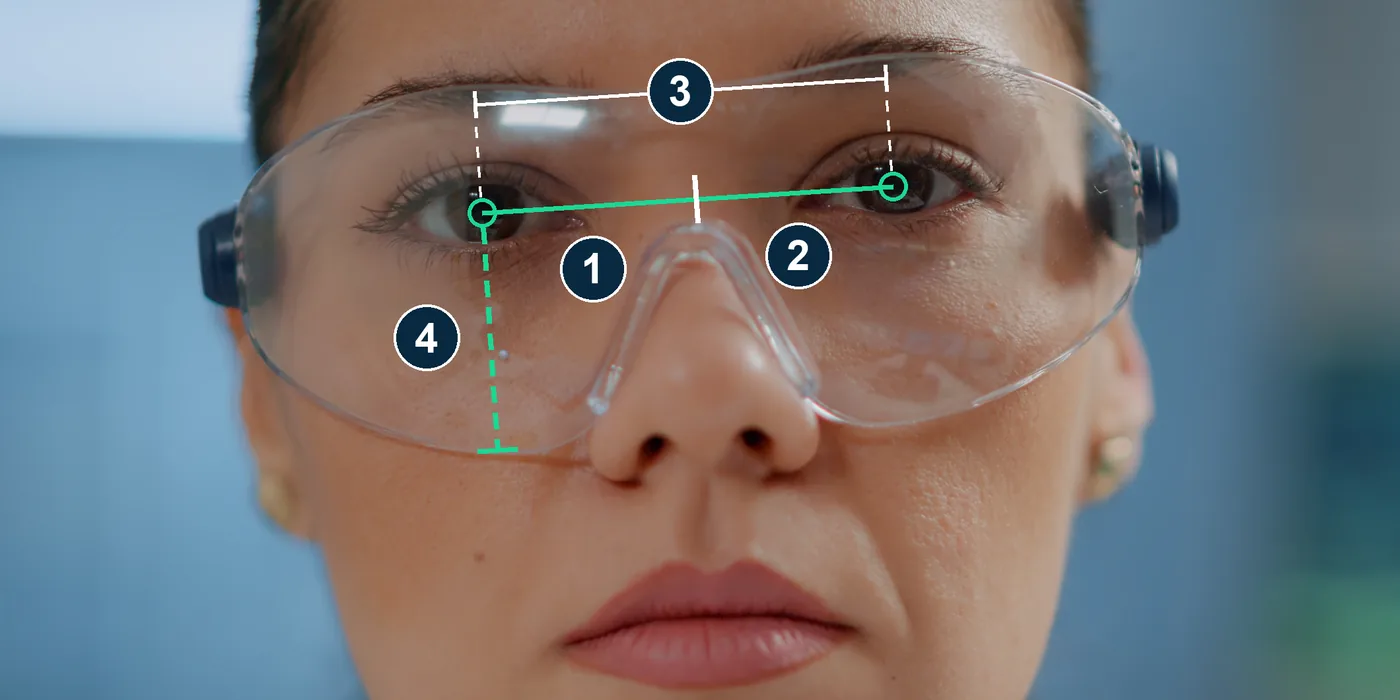
- 1Right monocular PD: from the centre of the pupil to the nose axis
- 2Left monocular PD: same measurement on the other side
- 3Pupillary distance: the sum of both monocular values
- 4Fitting height: from the pupil to the bottom edge of the lens
The figures below are general optical orders of magnitude. They are not instructions for any given safety frame.
| Measurement | What it is | Reference | How to obtain it |
|---|---|---|---|
| Pupillary distance (PD) | Distance between the centres of the two pupils. | About 63 mm on average in adults, mostly between 50 and 75 mm. | Face only |
| Monocular PD | Distance from each pupil to the nose axis. | Can differ between eyes. The two add up to the PD. | Face only |
| Fitting height | Distance from the pupil to the bottom edge of the lens, eye by eye. | Specific to each frame and how it is worn. | Frame worn |
| Vertex distance | Distance between the cornea and the back of the lens. | 12 to 14 mm. | Frame worn |
| Pantoscopic tilt | Tilt of the lens relative to vertical. | 7 to 12 degrees. | Frame worn |
| Wrap angle | Curve of the frame around the face. | About 5 degrees on a standard frame, often more on a wraparound frame. | Frame worn and manufacturer data |
The last three rows make up what opticians call the position of wear. The lab can use it to calculate the lens for the way it will really be worn.
Why a few millimetres change everything
When the eye does not look through the optical centre, the lens deflects the image: this is the prism effect. Prentice's rule calculates it simply: decentration in centimetres × lens power in dioptres. A 2 mm offset on a 4 dioptre lens produces 0.8 prism dioptres, which the eyes must compensate for.
On a progressive lens, the margin is narrower still. Distance vision sits at the top of the lens, near vision at the bottom, with a narrow corridor between them.
- A wrong monocular PD shifts the corridor away from the eye, making it harder to fuse the two images.
- A height set too high brings the progression zone into distance vision.
- A height set too low forces the eyes further down to read.
At the workstation, this is not only about comfort. Looking down on a ladder or a staircase means looking through the near zone. The choice between progressive, office and single-vision lenses is therefore made with the optician, taking the job into account.
What safety eyewear makes harder
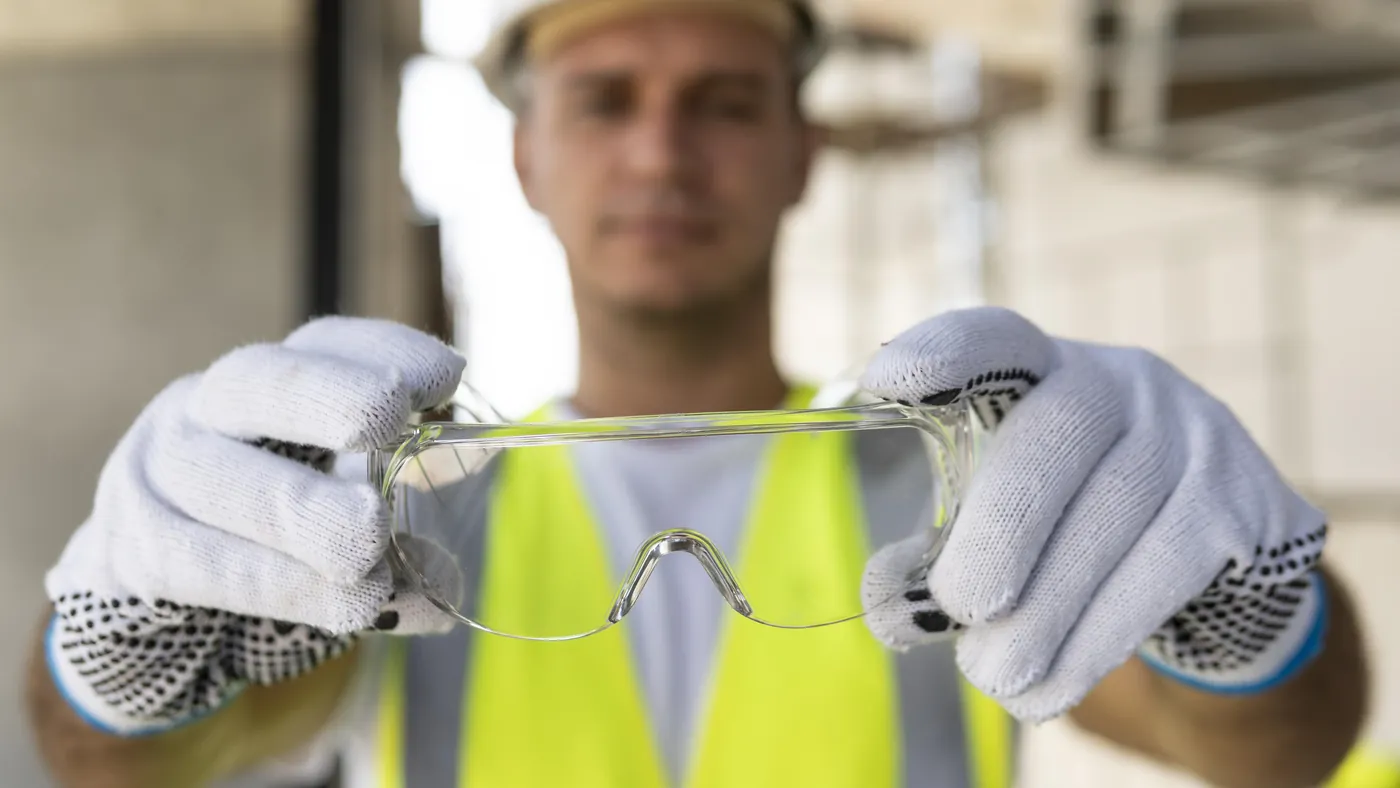
- Wrap. Safety frames often wrap around the face to cover the sides. Not all accept the same corrections.
- Real-world wear. A hard hat, a mask or a headband can change the position of the frame. Measurements must reflect how it is worn on the job.
- Manufacturer data. In the catalogues we reviewed, lens height, wrap angle and minimum fitting height are not always published. Without them, there is no way to check that a progressive lens fits the frame.
- Compliance. Protection is checked on the complete equipment. EN ISO 16321-1 now replaces EN 166: confirm the marking of the frame and prescription lens assembly with the manufacturer.
What the camera measures today
The method we are testing measures pupillary distances with the camera of a phone or computer, with no app to install. It takes four steps.
- Locate. 478 points are placed on the face and head position is checked. If the pose drifts too far, the tool asks the wearer to start again.
- Set the scale. An image has no scale. Camera measurement relies on the average iris diameter, 11.7 mm. Calibrated measurement relies on a printed marker of known size.
- Correct for convergence. At about 40 cm, the eyes converge on the camera: the measured distance is a near PD. The distance PD is calculated as measured PD × (d + 13) / d, where d is the distance to the camera in millimetres and 13 mm is the eye's rotation radius. At 400 mm, a measured 61 mm gives a distance PD of 63 mm.
- Separate the two eyes. Each monocular value is calculated from the nose axis, then the burst of images is aggregated. The total distance PD is rounded to 0.5 mm, and each value shows its margin.
Fitting height and position of wear cannot be deduced from a front photo without a frame. We are working on these measurements, and will not announce them until they are validated.
What this changes for a company
Equipping several sites today means organising store visits or bringing an optician on site. Our view: that appointment keeps all its value, but it can be better prepared. Here is the journey we are aiming for.
- The wearer measures themselves from a phone or computer, without their glasses, in under a minute.
- Incompatible frames are ruled out using the manufacturer's published dimensions.
- The optician checks the measurements with the frame worn, and takes the fitting height.
- The company tracks progress by site, as with a WeeFizz PRO allocation campaign.
On privacy, the analysis runs in the browser. The measurement does not require the prescription, which remains health data, and the image is neither sent nor stored.
What we are still validating
- Accuracy. With the iris alone, the margin remains about 5 mm, because iris diameter varies between people. The printed marker aims to reduce it.
- Field validation. The next step is a comparison on real faces, against a calliper and opticians' devices.
- Wearing glasses. Prescription lenses distort the scale taken from the iris: wearers must remove them during the measurement.
This method does not replace measurement by an optician and produces no prescription. It helps prepare the optician's work, and missing data is reported as missing.
Frequently asked questions
What is pupillary distance?
It is the distance between the centres of the two pupils, in millimetres. It averages about 63 mm in adults and is mostly between 50 and 75 mm.
What is the difference between PD and monocular PD?
PD is the total distance between the two pupils. Monocular PD runs from each pupil to the nose axis. It is measured eye by eye because the two sides can differ, which matters especially for a progressive lens.
What is fitting height?
It is the distance from the centre of the pupil to the bottom edge of the lens, eye by eye. It depends on the frame and its position on the face, so it is measured with the frame worn and adjusted.
Can pupillary distance be measured with a camera?
Yes, provided there is a scale reference and the convergence of the eyes is corrected. WeeFizz is testing this method. The optician keeps the final validation, especially for progressive lenses.
Which standard applies to prescription safety glasses?
EN ISO 16321-1 now replaces EN 166 for occupational eye protection. Confirm the marking of the frame and prescription lens assembly with the manufacturer.
Is the face image stored?
No. The analysis runs in the browser, and the image is neither sent nor stored. The measurement does not require a prescription.
Do you make, distribute or fit safety glasses?
Let's test the method on your frames and technical sheets.
Write to us →Sources. Dodgson, Variation and extrema of human interpupillary distance, SPIE, 2004 · Eyecare Business, Necessary Measures, 2015 · 20/20 Magazine, The Real Details of Vertex, Tilt and Wrap · EN ISO 16321-1:2022 record.