Length
It gives the size. Measure both feet and keep the longer one.

Solutions
 PPE guide · Footwear
Safety shoes: foot length gives the size. Toecap width decides comfort, and it changes from one model to another.
In short: measure your foot length, from the heel to the tip of the longest toe, then read the manufacturer's size chart. Then check the width: the minimum toecap length is standardised, its width is not. Have shoes tried on before ordering for a whole team.
It gives the size. Measure both feet and keep the longer one.
It depends on the model: compare several suppliers if the toecap pinches.
Two to five days of wear by a representative group, according to the INRS.
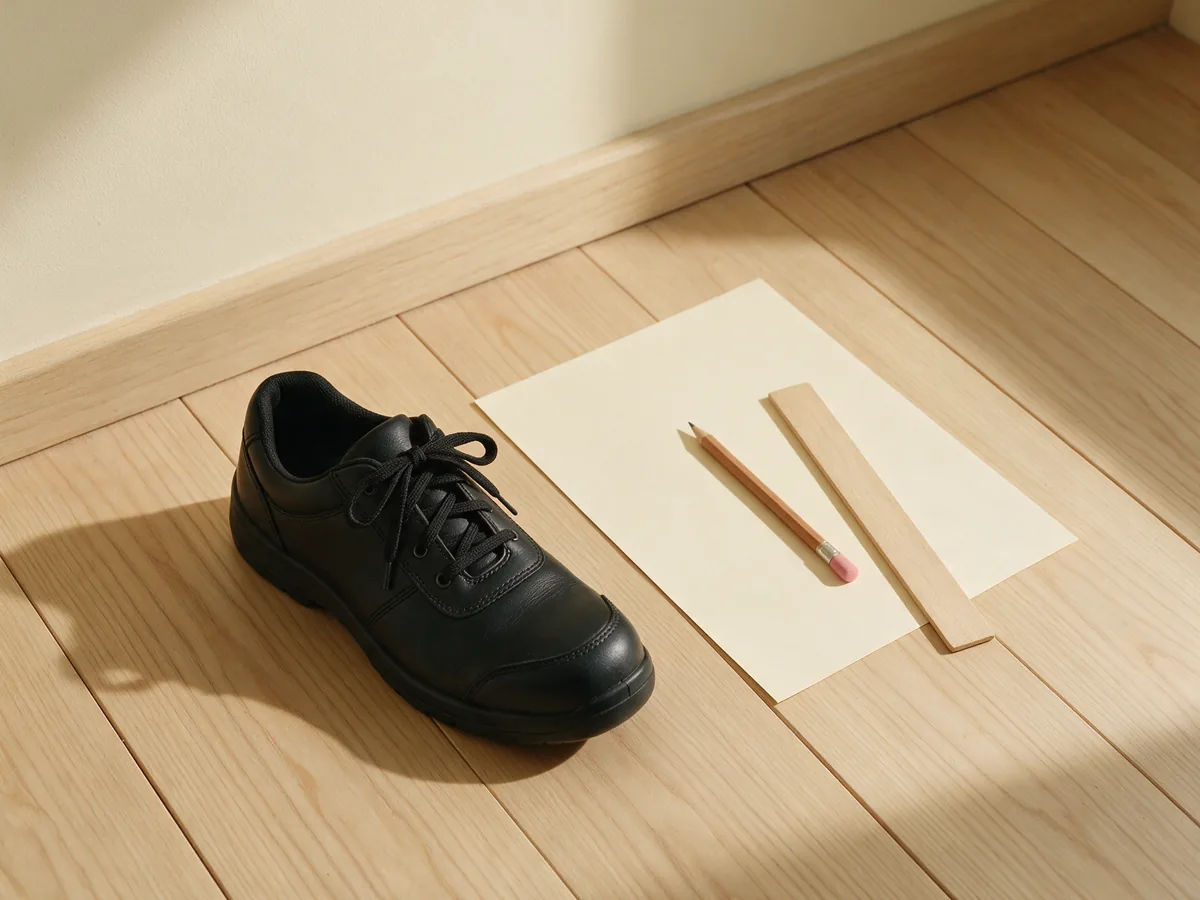
Heel against a wall, wearing the socks you wear at work. Body weight spread over both feet.
A line in front of the longest toe, pencil held straight.
From the wall to the line. Repeat with the other foot and keep the larger value.
An orthopaedic insole or thick socks change the volume: try the shoes with them.
Estimate using the common method: (foot length in cm + 1) × 1.5. The manufacturer's chart takes precedence.
| Foot length | Mondopoint (ISO 9407) | Estimated European size |
|---|---|---|
| 23 cm | 230 | 36 |
| 24 cm | 240 | 37 or 38 |
| 25 cm | 250 | 39 |
| 26 cm | 260 | 40 or 41 |
| 27 cm | 270 | 42 |
| 28 cm | 280 | 43 or 44 |
| 29 cm | 290 | 45 |
| 30 cm | 300 | 46 or 47 |
Counted in Paris points: 1 point = 2/3 of a cm (6.67 mm). It measures the shoe, not the foot. UK and US sizes use other scales: take the conversion from the manufacturer's chart.
ISO 9407:2019 marks foot length and width in millimetres, for example 280/110.
Try both. If the toecap pinches, try a different width or model rather than going up and up in size.
| Reference | What it says | Effect on size |
|---|---|---|
| EN ISO 20345, safety footwear | Toecap resisting an impact of at least 200 J and compression of at least 15 kN. | None: the size is chosen with the manufacturer's chart. |
| EN ISO 20346 and 20347 | Protective footwear (toecap 100 J, 10 kN) and occupational footwear (no toecap). | Same measuring method. |
| Categories SB, S1 to S7 | Groups of requirements: S1, S2, S3, S6, S7 for leather, S4, S5 for rubber, SBH for hybrids. S3S, S3L, S7S… specify the type of perforation-resistant insert. | None. An S3 and an S1 from the same manufacturer can fit differently. |
| Toecap | Standardised minimum length, from 34 to 42 mm depending on size. Width left to the manufacturer. | Decisive: a narrow toecap hurts a wide foot, even in the right size. |
Key point: the INRS recommends issuing an individual pair to each worker and offering suitable ranges, including for women. The French Labour Code reserves PPE for personal use (article R4323-96).
Other items: PPE size guide and safety glove size chart.
It depends on the model and the manufacturer. The protective toecap has a minimum length set by the standard, from 34 to 42 mm depending on size, but its width is free. Two models of the same size can therefore fit differently: compare several models and try them on before rolling out an order.
A common method is to add 1 cm to the foot length, then multiply by 1.5 (one Paris point is 2/3 of a cm). A 26 cm foot gives about 40 or 41. This is an estimate: the manufacturer's size chart remains the reference.
Not as a rule. Take the size that matches your foot length in the manufacturer's size chart. If the toecap pinches the toes, the INRS notes that changing size or choosing a wider model often solves it.
They are EN ISO 20345 categories that group performance requirements: S1 adds in particular an energy-absorbing heel and an antistatic sole, S2 resistance to water penetration of the upper, S3 a perforation-resistant insert and a cleated outsole, S7 resistance to water penetration of the whole shoe. They say nothing about size.
According to the INRS, safety footwear (EN ISO 20345) has a toecap resisting 200 J and 15 kN of compression, protective footwear (EN ISO 20346) a toecap resisting 100 J and 10 kN, and occupational footwear (EN ISO 20347) has no toecap.
The INRS recommends having several models, ideally from different suppliers, tried by a representative group of workers for two to five days, and collecting their feedback on a trial form.
Sources: INRS (French national research and safety institute), ED 6509, foot and lower-leg PPE (2nd edition, June 2025, in French); ANSI, ISO 9407:2019, Mondopoint system; Wikipedia (French), Pointure (Paris point, conversion method); French Labour Code, article R4323-96. Checked on 11 October 2026.
Show us your items and size charts: we will show you a campaign set up for your sites.